Adding Leads Agent.
Turns an ICP into a batch of qualified, deduped leads — outbound-ready.
End of run
A payload of fresh, ICP-matched B2B leads, never previously contacted, filtered against the live CRM, scored and rationalized by Claude Opus, handed back to the caller in ~45 seconds, ready to drop straight into the outbound queue.
The run names from history tell the story of how it actually gets used: “Building Materials Leaders Canada US,” “Industrial Distribution Leaders US Canada Search,” “Plumbing HVAC Leaders Search,” “Electrical Distribution Leaders.” One agent, many verticals, one ICP at a time.
332 runs in production at $0.82 each. Opus isn’t cheap, but Opus is what makes the qualification reasoning hold up.
Challenges it solves
Apollo returns thousands. You want the right twenty. The agent composes a tight Apollo search query per ICP, pulls candidates, then has Claude Opus reason over each one against the customer-profile definition before anything ships back.
Never re-contact a lead. Before search, the agent fetches the blocklist of already-contacted prospects and queries the SQL database of existing CRM records. Apollo results get filtered against both, so by the time Claude scores anything, the duplicates are already gone.
Handle empty searches gracefully. Run history is dotted with “Search Returned Zero” and “Search Returned Empty” results. The agent doesn’t error out when Apollo has no matches; it returns a clean “no new leads for this ICP” response so the caller can rotate to the next vertical.
Reasoning that actually scales. Cheap models miss nuance on B2B qualification (industry adjacency, company size signals, “real” decision-maker vs. job-title noise). Opus does this well enough that the qualified leads coming out are actually qualified.
Under the hood
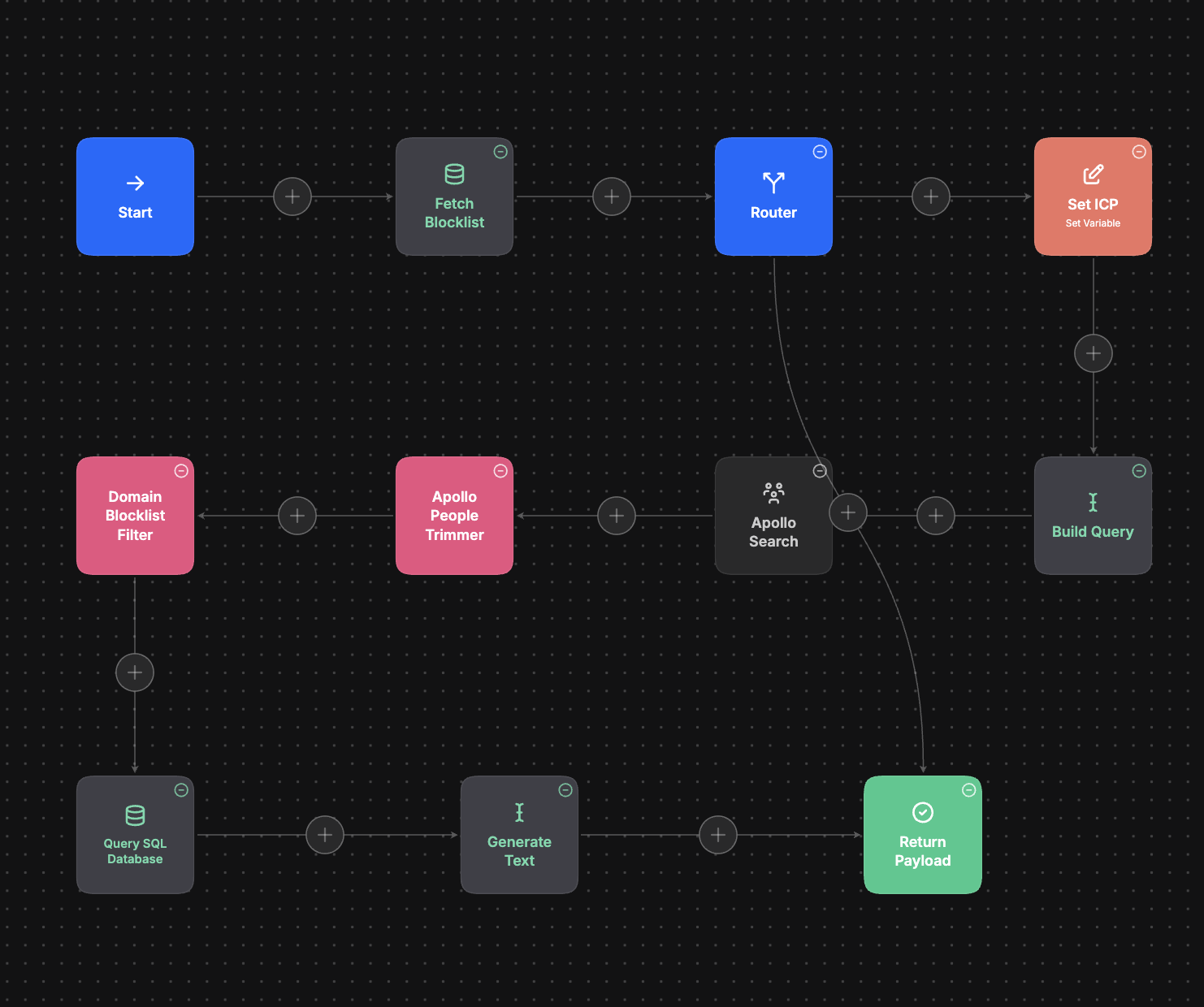
Single-flow agent: Start → Fetch Blocklist → Router → Set ICP → Build Query → Apollo Search → Execute Function (dedupe vs SQL) → Generate Text (Opus qualification) → Return Payload. The Router
picks the right ICP branch based on input; everything downstream
is deterministic until the final qualification pass.